Showing posts with label Spain. Show all posts

Monday, 18 June 2018

San Sebastian – foodie's paradise

Leaving Oñati we took the winding road over the mountain.  They had signs nearly all the way up giving you a speed limit of either 20kms or 30kms depending on the bends.  We were lucky if poor old Sonny, the motorhome could reach those speeds as he chugged his way up.
Sat-Nav showing the winding road going over the mountains

View over Oñati  and the mountains half-way up
We eventually joined up with the free motorway that took us into San Sebastian. The last time we were in San Sebastian was 5 years ago and it poured down with rain and we never got chance to have a good look around the city.  We have attempted to stop twice more since then, as we have driven past on our way through Spain, but again on both occasions it was pouring with rain again so we never bothered. So, this time having checked the weather before setting off it was showing part sun/cloud with no rain expected until late evening.  True to its word, when we arrived the sun was shining – result!  
The Aire (N43.30811 W2.01451) is about 4.5kms from the town and the only one with motorhome facilities.  It cost €7.60 for the night, in what is basically a car park with the usual water and dumping facilities.
The walk in to the town took us along the sea front and along the La Concha Beach – voted as one of the top best urban beach in the world for its seascape, environment and fine white sand.
Mount Urgull, seen from La Concha Beach
Time for a quick bit of history folks!   At the foot of Mount Urgull there used to be a small community of fishermen who became world-famous for whaling and cod fishing.  In 1808 Napoleon’s troops captured the city and in 1813 the Anglo-Portuguese troops raided it killing most of its inhabitants.  They then destroyed it burning all its buildings.  Those who survived decided to rebuild the city and today it has a population of approx. 190,000.  Wow, these people were so resilient in those days.  The city is known as either Donastia (Basque name) or San Sebastian (Spanish name) and both mean Saint Sebastian.
Town Hall – opened in July 1897 and was the venue of the Great Casino until it was closed in 1924 due to illegalisation of  gambling. It reopened January 1947 as the current Town Hall. 
Plaza de la Constitución –  at the top of the windows there are numbers (1-147) from its past when the square was used as a bullring and the spectators hired out the balconies. The central building used to be the City Hall.
Santa María Basilica - wedged in among the bars and high apartments of the narrow streets
Sculpture of La Piedad by Oteiza on the side of San Vicente Gothic Church.  Apparently, represents Jesus dead in the arms of his mother, Mary - you draw your own conclusions!
San Sebastian is well known for its pintxos. We have read that the best way to eat and drink in San Sebastian is to walk around the many bars/cafes that they have, sampling 2/3 different Pintxos in each one along the way and of course a few drinks with it to wash it all down!
Pintxos laid out on the bar - they give you a plate and you help yourself to as much as you want and pay at the end.
We decided to pace ourselves and started off with 3 hot and 3 cold.  It's not cheap but was really tasty, this little lot cost us 21 Euros.
After that it was time for a little walk before we got some more food and drink.  From the old port it is about 1.5km to the top of Mount Urgull, where you get a great panoramic view across the city.
Panoramic view from the top of Mount Urgull
Isla Santa Clara in the middle of the sea - you can get a boat out to it from the port.
At the top there is a museum at the top but unfortunately it is all in Spanish so no good for us when we can only string a few Spanish words together!  There are stairs in the museum, where you can climb to the top of La Mota Fortress, which has been declared an Historical Artistic Monument.


Palacio Miramar – English style palace built by the Spanish Royal Family
Puente María Cristina with its 18m tall obelisks, opened in 1905
By the time we got back from San Sebastian, the Aire was full, mostly French and Brits and we were all packed in like sardines!  We had planned to stop another day but woke up to more rain, so it was time to move on into France.
The quickest and best way to get out of San Sebastian and across the Pyrénées is to take the motorway, most of which are paying ones.  It wasn't too expensive though, we ended up on 4 at a cost of €15, travelling just over 110kms.  Once into France the weather changed completely, temperatures rose and the sun came out.  Our first stop was at a little town called St Paul-les-Dax, beside a lake and well known for its thermal springs.
The Aire turned out to be a disappointment as it was in the middle of woods, very muddy and surrounded by high trees – no good when temperatures were soaring to 27°C and we needed to get some sunrays!  Luckily, we had stopped off earlier in the town to do some laundry and had spotted about 10 French motorhomes parked up.  They had created their own Aire in an open space, near to the lake and we went and joined them, chairs came out and barbeque lit!
St Paul-les-Dax  
From St Paul-les-Dax we moved further north to a little village called La Sauvetat du Dropt.  I hadn’t done much driving at all over the last 4 months, as we have only been travelling short distances.  But the roads in France are nice and wide for motorhomes, mostly straight and tree lined and the French drivers are not too erratic - so Mel let me get behind the wheel!
The Aire takes 4 motorhomes, on the side of the river (N44.64733 E000.34181).  Not much in the town but a nice place to relax for the afternoon/evening.
Old mill house just across from the Aire
BBQ time!
Moving on this morning, we have just come up the road 17 miles (27 kms) and are parked up on a vineyard, Domain de La Lande in a village called Montbazillac (N44.78818 E0.49681). It's a France Passion site but also an Aire for motorhomes.  We were France Passion members in 2013 and 2014 when we used to come to France a lot and stay on vineyards and know they are all very welcoming places to stop on.  The owner welcomed us and gave us access to all the free facilities - water, toilet, etc.  We are surrounded by vineyards and you have your own seating area and even an area for barbecuing.  What a perfect spot.
Sonny, the motorhome nestled in among the vines
Since coming into France a couple of days ago, all we have seen on the road and Aires are French motorhomes, as they are not really touristy areas that we have been travelling through/stopping at.  However, pulling up on the vineyard there is 1 Brit and 3 Irish motorhomes.  The 3 Irish are travelling around together and like us, all 4 are making their way north.  
Wine tasting starts at 6pm – looking forward to that!  Then it’s England’s first match in the World Cup, and Mel has managed to pick up English TV on our Satellite Dish so he is a happy chappy – come on England!
Quick weather check shows that the temperatures from tomorrow are going to soar to 30°C around the Dordogne and so we are going to head to a campsite we stayed on a couple of years ago, kick of our shoes and lie in the sun.

Sally x

UPDATED - photos added from wine tasting.  Jean, our host only spoke French and we were 9 English people but between us we managed to translate what he was saying!
Ready for wine tasting in the cellar with our host, Jean Camus


All smiles after wine tasting complete and bottles bought!
Sobering up the next morning with coffee and Pan Au Raisin, delivered fresh by the bread lady to our door!


Thursday, 14 June 2018

Burgos – Home of the legendary El Cid

After 2 days of non stop rain, it finally stopped and the sun came out - yeah!  Since coming into Spain the weather hasn't been brilliant but to be fair we have been stopping in places that are nestled in the mountains, at altitudes between 650-800 metres.  Our next stop was Burgos, where we spent 2 days/night on an Aire at the edge of the new town, near to a park (N42.35018 W3.68078).  It has all the usual facilities, and although full of motorhomes coming and going over the 2 days it was very quiet.  Burgos is a sprawling concrete jungle, with high-rise buildings dominating the sky line and driving in at first we wondered whether we wanted to stop here at all, not being city lovers and all of that! However, that said the old town is beautiful.  From the Aire it’s about a 2.5km walk to the old town, along the river Arlanzón.
Paseo del Espolón – lined with trees and 19th century iron gas lamps
Rodrigo Díaz de Vivar, otherwise known as El Cid (The Lord Champion) was born in Burgos in 1043, and died in Valencia in 1099.  He was a famous Spanish national folk hero, who symbolised chivalry and virtue.  His body is buried in Burgos Cathedral, along with his wife Doña Jimena.
El Cid
The main gateway into the old town is Arco de Santa María, one of 12 original medieval gateways to the city.  In its alcoves are key figures from the city’s past.
Arco de Santa María
I know I said in my last blog that we had over done it with castles, churches and cathedrals over the last month but we couldn’t come to Burgos and not go inside this beautiful cathedral.  It is the only cathedral in Spain to be declared a UNESCO World Heritage site in its own right.
Burgos Cathedral - 13th century Gothic, modelled on the cathedrals of Paris and Reims.
The cathedral is enormous and from the outside the architecture from every angle is incredible.  Inside you are dazzled by the amount of golden bling from the main chapel, to all the small ones that surround it.
Cloister Door
Main altarpiece in the central nave
Tomb of fabled 11th century commander El Cid
Ornate ceiling in the central nave
Golden stairway leading to the north door (Puerta de la Coroneria), that's only open during Easter weekend.
Puerta de la Coroneria, (twelve apostles) that access the golden stairway
Chapel del Constable, one of the many side chapels
El Cid's Chest
Behind the cathedral is a steep walk up to the Castle, which dates back to 884, unfortunately there’s not much left of it apart from the ramparts.  This is largely due to when the French occupied it during the Spanish War of Independence early 19th century, and before abandoning it they set of an explosion that destroyed most of the castle.
Remains of Burgos Castle
View across the city from the mirador del Castillo
Medieval Well remains intact – 63.5 metres deep, 1.78 metres wide that used to provide water for those living in the castle - that's a long way down!
We left Burgos heading towards San Sebastian, not having a particular overnight spot in mind.  We headed out on the N1 and into Basque country, with beautiful views and scenery as it cut through the mountains.


We have ended up on an Aire at a little village called Oñati (N43.02742 W2.40495), on the edge of a national park.
Sonny, the motorhome in the middle of the picture.  His home for a couple of nights nestled next to a Spanish motorhomer!
We didn’t know anything about this area and heading into the town we were pleasantly surprised.    The University is one of the most important Renaissance buildings in the Basque Country.  Work began on it in 1540.
University

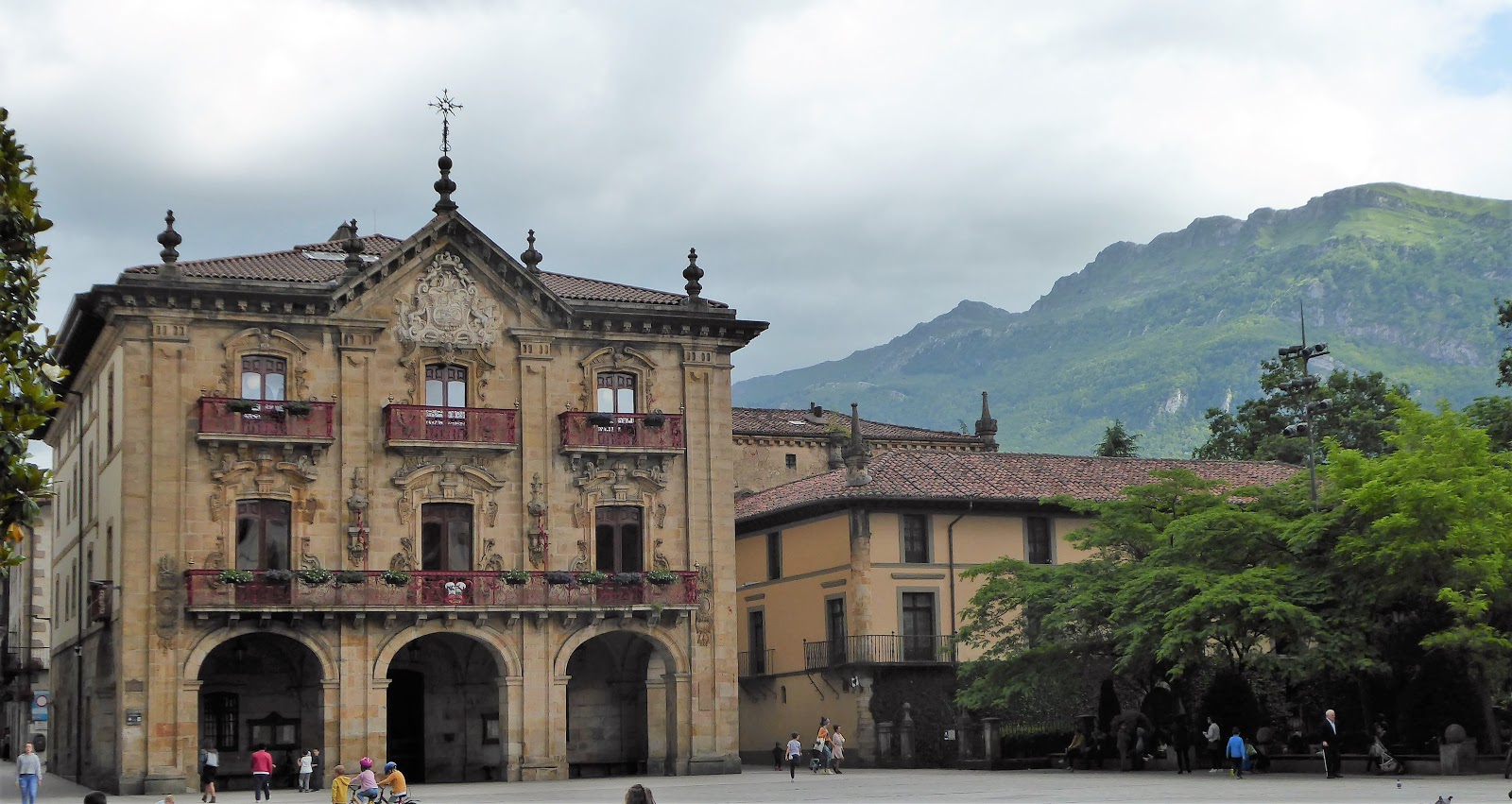
Baroque Town Hall
San Miguel Church - 15th century Gothic building in the main square
Tomorrow we head to San Sebastian, famous for all its tapas bars - bring it on!

Sally x

Tuesday, 12 June 2018

Tchau Portugal, Hola España

After 36 fabulous days in Portugal, we cross the border into Spain.  Our journey has been lovely, travelling on as many ‘roads less travelled’ and keeping off motorways as we criss-crossed our way from south Portugal to north.
Our journey across Portugal - in white
So, once again we are across the border into Spain and in the space of a second we have lost one hour of our lives as the clocks go forward! The only way you know you have crossed the border is the EU sign. The quickest route to our first stop is by motorway, most of which are free in Spain and the journey from Bragançto Zamora was quite pretty.
First stop back in Spain – the city of Zamora in Castella -León region.  It sits on the River Douro surrounded by its defensive walls, and was known as the ‘well protected’.  The Aire is next to a park and gives motorhomes their own little spot (N41.50351 W5.75648).
With being in Portugal so long we had completely forgotten about the Spanish siesta, where nearly everything closes between 2pm-5pm.  So, walking around the old town of Zamora during this period made it feel like a bit of a ghost town.  It was nice walking around its narrow cobbled streets, known as the city of Romanesque.  We find the architecture can sometimes be just as nice to see from the outside as in, plus we had been in enough castles, cathedrals and churches over the last few weeks to last us a while so we weren’t that bothered they were closed!
Zamora Cathedral
Zamora Castle
Plenty of storks nesting in this old church roof.

The Puente de Piedra (stone bridge) across the River Douro
Posing with the bronze sculpture of the maestro Herminio Ramos Pérez – a chronicler and journalist, he became the Voice of Zamora
On the Plaza Mayor outside the church is the scary looking  El Merlú together with El barandales  - representative figures during the Easter Holy Week . 

Old Town Hall
Very steep street leading down to the stone bridge across the river, that used to provided direct access to the centre of the city for traders
The next morning we were up and on the road early as we headed to Palencia – a 98 mile (157kms) drive and the longest distance we have driven in one day since the beginning of our journey.  The quickest route was by motorway, but nearly all of these are free of tolls and pass through some pretty countryside so the drive was quite pleasant.
The Aire (N42.01056 W4.54568) is all free and the facilities amazing.  You get the usual (water and chemical waste dump) plus electricity, heated shower/toilet block, secured Wi-Fi, washing/ironing room with washing powder provided and outside seating area with vending machines. The Aire is spotless and is cleaned about 3 times a day. It is owned and run by the garage across the road, which I guess relies on motorhomes filling up with fuel and spending in their little shop to cover the cost of providing it for free.
The only trouble was that it rained and rained and rained for the 2 days we were here.  It was a good job we had electric as there was no way our solar panel was going to keep our batteries charged up with no sun!
Sitting out the rain on the Aire at Palencia
In-between the rain we managed a walk into the town.  Like Zaomora, Palencia has some lovely Romanesque buildings and way too many churches!
Cathedral
Whilst we were here there was a music festival taking place - Palencia Sonora Festival.  It attracts over 20 artists that play music in the town and in the Parque de Sotillo, bit like the Leeds festival.  A large area of the park is cordoned off for the stage and is full of tents, that were in danger of getting washed away because of the rain!  Despite the rain the show still went on and we could hear the music going on at the Aire into the middle of the night.  Thank goodness for ear plugs!
Parque de Sotillo

One of the bands playing outside the town hall
Palacio de la Diputacion 


The main street

After Leaving Palencia, we have headed to Burgos and still it rains!  Fingers crossed the sun will come out soon and we can venture into the town.

Sally x