Showing posts with label Greece. Show all posts

Monday, 17 December 2018

Snowed in at Mondavio, Italy

This morning we woke up, looked out the window and was faced with snow!
Mondavio Sosta - view from our bedroom window!
About 8 inches of snow had fallen throughout the night!  Yesterday was sunny, and a bit cold but we did not expect snow.  Over the last few months we have been enjoying hot climates but today it is struggling getting above 0°C.
We left the Peloponnese 3 days ago via the Patras to Ancona ferry. The ship is humongous, it has a gymnasium, spa, massage and beauty parlour, casino and games room, 2 bars and lounge areas (one with a disco), 2 restaurants, a shop with the usual duty free stuff, and an outdoor pool and bar on the top deck.  We were the only motorhome boarding at Patras and were manoeuvred into a tight spot, packed in among some very big trucks - mostly Greek and Italian.
Cruise Olympia Ferry
The long corridor of cabins - Mel standing halfway down. The en-suite cabins are teeny though - we have more space in our motorhome!
The crossing took just over 21 hours, which included an hour stop off at Igoumenitsa to load on more trucks.  Although the ship’s big we could still feel the movement of it through the waves and we didn’t have the best of sleeps, the beds weren’t particularly comfortable either and the vibrating of the ship’s engines didn’t help.  It’s official – we are never going on a cruise!
Getting off the ferry was a shock to the system. Leaving Greece, the temperature was 18°C and sunny, arriving in Italy it was 5°C and grey!  There’s not much to see in Ancona, so once off the ferry it was a quick shop at Lidl to stock up the fridge and cupboards and then we headed north 43 miles (69 kms) through the Le Marche region of Italy to the little town of Mondavio.  It sits 280 metres up on top of a hill and is classed amongst the most beautiful villages of Italy.  The town has kindly provided a Sosta (official parking area for motorhomes) just outside the walled town with free electric, water and waste dumping area (N43.67733 E12.96165).
A 5 minute walk and you are in the walled town, we could tell by the houses and shops that it is a very affluent area of Italy.  Last year we spent a lot of time in Italy and on Sicily and noticed a clear divide between the north and south.  The south is very much controlled by the mafia and as a result is very run down, with poor road surfaces and rubbish everywhere.  Mondavio is dominated by its fortress.
Entrance across the moat into the walled town
The fortress Rocca Roveresca Fortress, built between 1482-1492
They had a little Christmas fayre going on, with Michael Bublé’s Christmas album blasting out through speakers and Father Christmas walking around on stilts!


It was Mel’s birthday, so that meant having a few cheeky wines in the local bar!
We loved this Christmas tree of bottles outside the bar
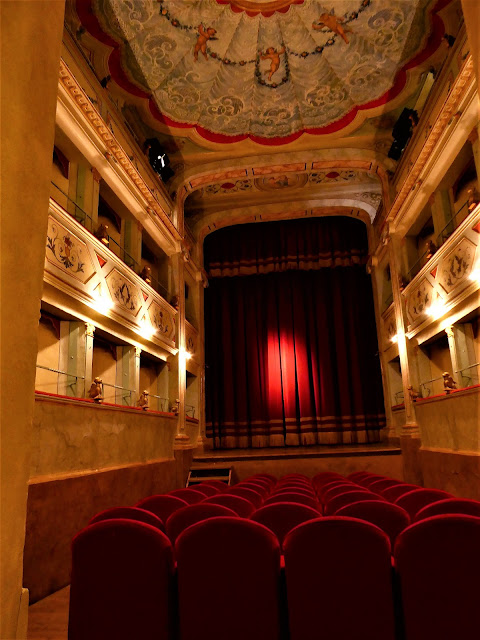
There is a lovely art nouveau style theatre in the town - the Apollo Theatre, which was once a 15th century church.  It so cute inside, with its small stalls area and box areas


In the evening we headed back into the town for a meal. Christmas celebrations were still going on, this time with a live band dressed up in Father Christmas outfits belting out some very old 'out of tune' American/English songs.  It was all good fun though and a great atmosphere.

Birthday meal for Mel. These have got to be the biggest pizzas we have ever had!
We had planned to set off this morning towards Milan but as we are snowed in (and it continues to fall as I write this) we may be here a while.  It is a lovely friendly place to be so we are not complaining!

Sally x

Thursday, 13 December 2018

Waiting for the Ancona Ferry at Patras

Leaving Diakofto we headed to Patras and our first stop was to a laundry.  Two machine loads later, all washed and dried, we parked up by the sea near to the port at Patras.  We are passing time at the moment, wandering around Patras, as we wait for the Cruise Olympia Ferry to take us across to Ancona.  It sets sail tomorrow (Friday) at 17:00 and gets us across to Italy on Saturday at 13:30 – a very long crossing! It’s a large ship though with plenty to do on board and we have booked a cabin, so will be sleeping for most of the journey.  Fingers crossed it's a smooth crossing, as I'm feeling a little sea sick just thinking about it.
Temperatures are dropping rapidly now and there is a covering of snow on the hills, so our winter fridge covers have gone on and our gas heating is working overtime. We can't grumble though, as up until 2 weeks ago we were sunbathing and swimming in the sea.
Snow on the hills of Patras
Patras is Greece’s third largest city, and has a large student population due to its university here.  The streets are vibrant and upmarket and it's all looking very Christmassy.  As we walk around the central streets there is Christmas music blasting out through loud speakers, playing the usual Christmas jingles – most of it in English!
Small Christmas market on the main square with Christmas characters.  Can you spot which one is Mel - ha ha!
It's beginning to look a lot like Christmas ,,,
Wherever you go in Greece, there is graffiti everywhere - on buildings, trains, walls, in fact anything that stands still long enough!  It appears that the only buildings that are not covered are those that are deemed sacred.  We haven't seen many that could be considered 'art' but we did like this piece drawn on the side of a building. 
Graffiti art in Patras
A steep walk out of the town, up a couple of hundred steps takes you to the medieval Castle of Patras.
The castle sits on the highest spot of the town, built on the site of the ancient Acropolis in the 6th century BC by the Byzantine emperor.  There is a lot of restoration work that has been carried out but to be honest not a lot to see. Entry was free though and from the top you get a great view across Patras.
Top of Patras Castle
By the look on Mel's face, I would say he has seen enough old castles and ancient Greek ruins to last him a lifetime!
There were a couple of ancient Roman remains - a theatre and stadium that we came across but weren't worthy of a photograph, and in the words of Mel 'more old stones lying on the ground'.
We will be sad to leave the beautiful Peloponnese. We have have spent 52 fantastic days on the Peloponnese and a total of 69 days in Greece and have travelled a distance of 1,637 miles (2,619 kms). Last year we spent nearly 3 weeks in mainland Greece and fell in love with the country but for us the Peloponnese outshines it any day. Below is a map of the route (green Line) we have taken in Greece and the Peloponnese.  It includes our trip last year (blue line) as well, as we didn't get around to buying a new one.
Our route outlined in Green.  Last year's route in blue.
My next chat to you will be from Italy!

Sally x


Monday, 10 December 2018

A wonderful Train Journey from Diakofto to Kalavryta

Temperatures have been up and down over the last few days.  The sun has been out and reaching 18°C but night temperatures dropping to 8°C, so we were glad to be staying on the camper stop at Ancient Corinth and to have electricity.  In fact, we didn’t want to leave and ended up stopping 5 nights.  Once we had seen the ancient ruins and castle, we spent the days wandering around the town, enjoying lovely meals out.  Then took a couple of scooter rides to the beach and generally just chilling. However, with our ferry booked from Patras to Ancona on 14 December it was time to make tracks.
So, with all of Sonny’s ablutions done we said our goodbyes to our German and Brit friends and headed west to Diakofto, making sure we avoided the toll road – it’s ridiculous the toll fees the Greeks charge, maybe it's so they can clear their national debt!
We took the coastal road all the way and having not been on the road for 5 days in the motorhome we needed all our focus on the crazy Greek drivers.  Their road sense is appalling – they pull out of side roads without looking - usually on their mobile phones, they overtake on double white lines, scooters and mopeds weave in and out, very few wearing helmets. and on some roads they decide to make 2 lanes into 4 as they beep you to move over onto the hard shoulder, as they overtake.  I would be surprised if half of them haven't passed a driving test.  Rant over!
The coastal road was pretty, but the sea was rough and poor old Sonny took a soaking most of the way.
Struggling to see through Sonny's windscreen as it gets covered in salty sea water.
We eventually arrived at Diakofto and parked up at the train station, ready to catch the train (Kalavryta Express) the next day to Kalavryta (N38.19152 E22.19896)On the grounds of the old railway station sits an old locomotive - number 8003 and is now preserved as a monument having served the route for 70 years back and forth to Kalavryta.

In the old train yard sits even more old railway carriages.
The railway line is an old rack and pinion line built by the Italians between 1889 and 1896 to bring minerals from the mountain to the sea and is one of the narrowest railways in the world (75 centimetres wide). The trains travel all year round, regardless of weather but there are only 3 a day, so we opted for the 11.30am journey out and 3.30pm return. A return ticket costs a whopping €19 but believe me it's worth it!
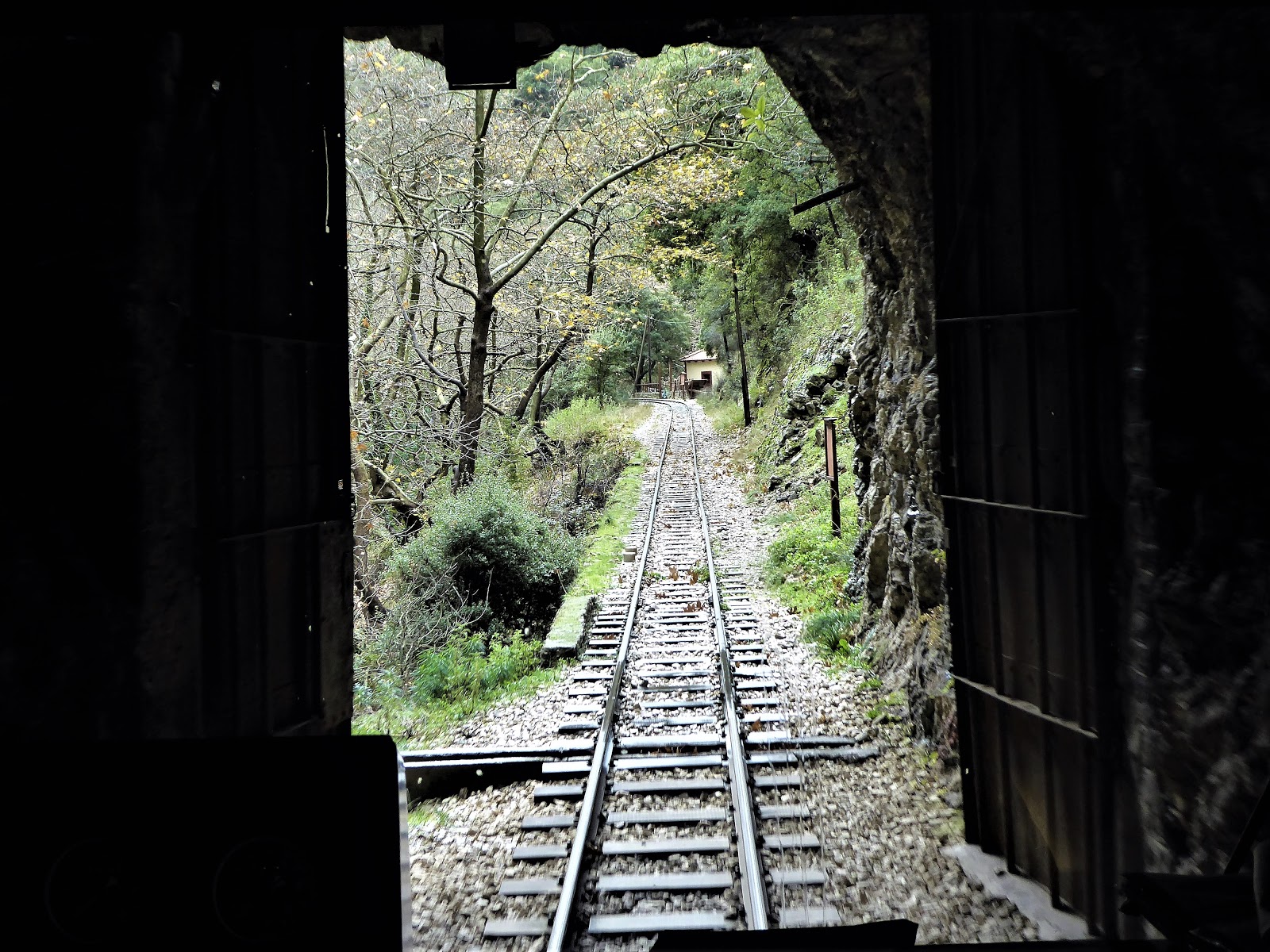
Eagerly we boarded the train and got a seat right at the front.  It headed up through the dramatic Vouraikos gorge, that follows the river of the same name most of the way into the mountains.  Climbing from sea level to 720 metres - a journey of 22kms that takes about an hour, as it cuts through the gorge, through tunnels, over bridges and passed waterfalls. For most part the train moves on conventional rails at speeds of about 30km/h; however, when the gradient exceeds 10% it moves on the toothed rack using rack gears and slows to between 6 to 15 km/h.


Old iron doors remain.  The narrowest part of the route and once only opened to allow the trains through and blocking access to walkers


Kalavryta is a small hillside town, that sits below Mount Helmos.   It's a ski resort, one of the largest in Greece and we spotted snow on the hilltops.  Luckily we were wrapped up warm.
It is hard to comprehend the atrocities that took place during World War II.  When 77 German soldiers were taken prisoner and executed by the Greek Resistance, the Nazis took their vengeance out on the town of Kalavryta.  On 13 December 1943 they rounded up the inhabitants and locked the women and children into the town’s school.  All males over the age of 12 were taken out to Kapi hill overlooking the town and shot.  Over 1,200 males residents of Kalavryta were gunned down.  The German’s then went on to burn the town to the ground.  They managed to escape by breaking down the doors before it was burnt down.  The school house where the women and children were locked in is now the museum. Being a Monday, the museum was closed, but we had read a lot on the internet about the history and for us it was more about visiting the memorial on Kapi Hill.
A woman with her children dragging her husband's dead body to a grave.
The clock on the church remains fixed at 2.34pm - the time of the massacre
Inside the rebuilt church are 6 remaining pillars of the old church, that stand a few feet short of the roof.
Memorial on Kapi Hill.  At the top sits a large cross, underneath is the date of the massacre.  At the bottom a sculpture of a hurt mother next to the underground cemetery where there are small oil-lamps - one for every family.  There are columns that surround the spot with the names written on of the families of the victims.
The large white cross overlooking Kalavryta
We have visited a lot of memorials over the years but we found this one the most moving and reduced me to tears. We headed back to the town and walked the cobbled street that is lined primarily with ski and hiking shops.  Along with umpteen cafés and tavernas.  We weren't that hungry so just opted for a gyros (which has become our favourite Greek fast food snack) and then headed back to the station.  We did not want to miss that last train back!
The last train back to Diakofto sits in the station at Kalavryta
On the journey back we decided to sit in the end carriage and had it all to ourselves
It was an amazing journey and one we will never forget.

Sally x

Saturday, 8 December 2018

NEWS FLASH - Read All About It!

Our local newspaper, The Northern Echo and North East Living Magazine has done an article on our 2-year motorhome travels around Europe and North Africa. You can read the article on line (pages 98-99) -  North East Living Magazine [Link]


Hope you enjoy reading the article.

Sally x

Friday, 7 December 2018

Ancient Corinth- more ‘ancient’ Greek stones!

Ancient Corinth was once the capital of the Roman Empire.  Destroyed by the Romans in 146 BC, it was later rebuilt in 44 BC under Julius Caesar. It was a key centre for both the Greek and Roman worlds as possession meant control of trade between northern Greece and the Peloponnese and resulted in many invasions and power struggles over the years.  The guide books say that the ruins of Ancient Corinth are an impressively excavated city and is one of the high points of a visit to the Peloponnese. So, we were keen to visit – even though we had seen quite a few ancient stones now in Greece!
The camper stop is only a 400m walk to the village, which sits right next to the ancient site.  Entry is only €4 and that includes a visit to the museum as well. However, if you want to save you hard earned cash and are not bothered about going inside the museum you can see nearly all of through the fence that surrounds it or from the road that leads up to the castle.
I am not sure if we have seen too many ancient stones now in Greece but we are getting rather cynical about it all and as we went around the site we started to wish we hadn't bothered.  The site's fairly large but if I had to sum it up it consisted of half a Doric Temple, an old fountain, remains of an old market place and an array of scattered stones everywhere.  Outside the main site are remains of 2 theatres – one Roman and a larger Greek Theatre, used by the Romans for gladiator battles – although there is very little left of either and leaves a lot to the imagination.  It's a shame there isn't more information around the site that helps bring it to life, rather than seeing a pile of old stones!
Temple of Apollo – where 7 austere Doric columns still stand
The Acropolis towering over the Ancient city


Remains of an old market place

The Bema sits the marble platform used by St Paul in his defence against the charges brought against him by the Corinthians for illegal teachings. St Paul stayed in Corinth for 18 months (51-52 AD) attempting to change the ways of the citizens - mostly regarding the loose living, at one time over 1,000 prostitutes lived within the city. 
Inside The Bema
Random Statues scattered around, not sure why they are always headless!
Inside the museum is a collection of excavated items.  Mostly domesticated items such as ceramic pots, jugs etc, women’s jewellery and accessories and various household items, numerous Roman headless statues, and a couple of mosaics.
Head of Dionysos covered with fruit and ivy
Ceramic pot depicting a battle
War was an integral part of Greek life. Every soldier wore a helmet, carried a spear, sword and shield.  Once the battle ended a truce was called, the dead buried and the victors of the battle set up a trophy to commemorate their victory. 

Corinthian women were renowned for their beauty and much sought after as courtesans – beauty products that were found in the ground
Roman Fountain of Peirene – you can hear the water flowing through the underground cisterns that now supply the modern village
The modern village of Ancient Corinth is small but full of souvenir shops, coffee shops and tavernas – all touting for the tourist's money. There were a couple of coach loads in – one group of Americans and the other Japanese, presumably come of the cruise ships at the Port of Korinthos.
The following day we took a scooter ride up to the castle (Acorinth), that towers 565 metres above Ancient Corinth.  You get an amazing view over the Gulf of Corinth and the Saronic Gulf and can just about make out the Corinth canal that links them.  It sits on a mass of rock and is largely encircled by 3kms of wall. It was free to get in and there was some restoration work being carried out, so not sure who is funding that!  There are a lot of remains – a jumble of chapels, mosques, houses, Turkish bathhouses, and a Frankish tower - all erected over time by Greeks, Romans, Byzantines, Frankish crusaders, Venetians and Turks.
View over the Gulf's from the top

The inner remains of the castle
Having a daft moment!
The camper stop has some long-termers stopping on it - 4 overwintering Germans, and a couple of Brits who organised a BBQ late yesterday afternoon. Vasilis, the owner has a relative that makes wine that comes in plastic bottles and it's lovely.  Needless to say, much food and drink was consumed! 
I promise my next blog won't consist of any ancient stones lying on the ground!


Sally x